
“21st February 1952 – The 74 Years Anniversary of Glory & Legacy…”🪷🇧🇩

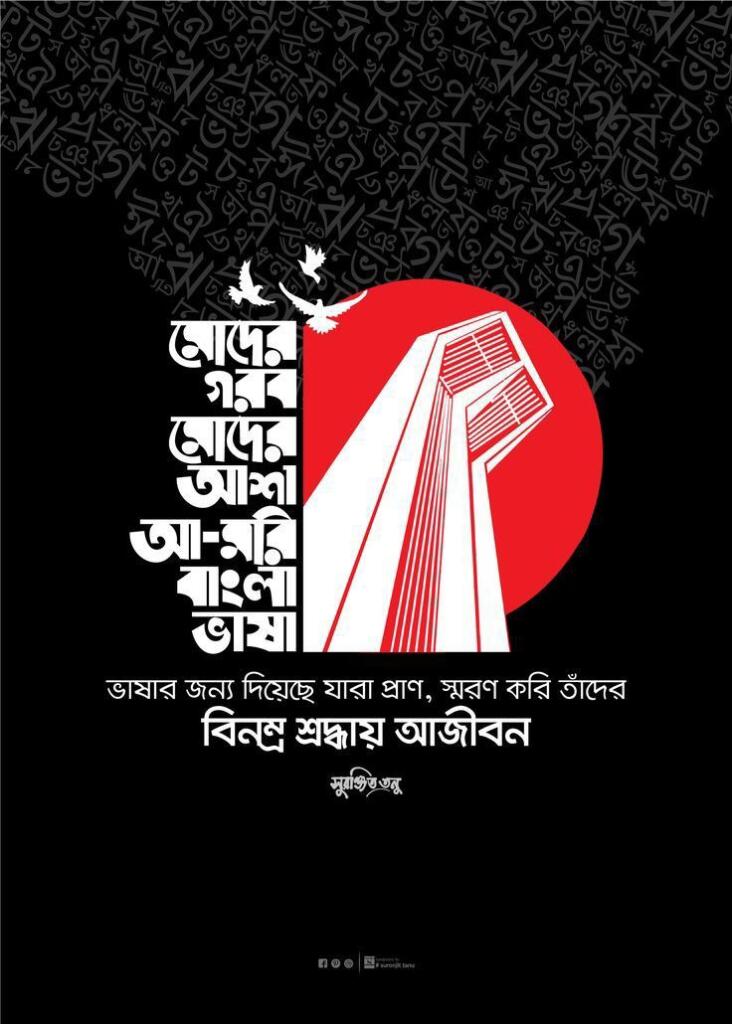
The 21st February is one of the most significant days in the history and calendar of our Bangladesh. For us, this day symbolizes both our grief, pride and glory at the same time.
The struggle for the equally deserving right and justice for our mother tongue, Bangla actually started in 1948, right after the separation of India and Pakistan. In March 1948, Muhammad Ali Jinnah declared in Dhaka that “Urdu, and only Urdu” would be the state language of Pakistan. In other words, the central government of Pakistan (dominated by West Pakistan) aimed to establish Urdu as the sole state language, despite the majority of the population residing in East Pakistan and speaking Bengali. The Tamaddun Majlish, led by Prof. Abul Kashem, initiated the resistance in late 1947. Ultimately, sparked by 1948, this language movement peaked on 21st February 1952 (8th Falgun 1358) when student activists at the University of Dhaka bravely defied the local government restrictions aka Section 144 in order to hold a procession. Various slogans such as “O, A, Ka, Kha”, “Rastrobhasha Bangla Chai”, “Tomar Amar Matribhasha Rastrobhasha Bangla Chai” echoed all over the streets, surroundings and the whole atmosphere of Dhaka. Then came the police and they charged batons, sprayed tear gases in that protest, beat and arrested some of the protestors. They did almost everything to stop the procession. At last, when all of their attempts failed, they mercilessly opened fire on the rally, resulting in the deaths of several students and activists, including Barkat, Salam, Rafiq, Shafiq, Jabbar and many more. Meanwhile, Shafiur and some others were killed sometime later after 21st February. This not at all controlled or stopped the movement. Rather, it climaxed even more than ever.
This sorrowful incident of irrecoverable loss enraged the Bengalis of East Pakistan even more. These unjust, cruel killings fuelled widespread public anger and united the entire population against the central government in West Pakistan. Finally, the intense public pressure, advocacy, nationwide unrest and the movement directly contributed to the official recognition of Bengali as the state language of East Pakistan in the constitution on 29th February, 1956.
The 21st February of 1952 was the day of our first movement, our first step of demanding our deserving justice and rights towards our freedom and triumph. Because of this day, the constitution was ammended and the law was enacted to recognize Bengali as one of the official state languages of Pakistan alongside Urdu, something we never even dreamed of being possible. The language martyrs of this movement are, in fact, the first martyrs for our country. Furthermore, this day ignited our spirit of courage, liberty, sense of political, social and cultural personality, a distinct Bengali identity and existence. Fostering and paving the way for the Bengali nationalism, the movement of this day eventually acts as the base leading towards the 6-Point Movement in 1966, the Mass Uprising in 1969, and lastly the Liberation War from 26 March to the ultimate victory on 16 December in 1971.
This day is the epitome of our legacy, the paradigm of our bravery, sacrifice, patriotism, our identity and existence. February 21 is now observed as the Language Martyr’s Day in Bangladesh and International Mother Language Day worldwide. Today, it is annually celebrated by typically wearing black and white traditional attire, walking barefoot in the early morning procession aka “Probhat Feri”, then placing & offering flowers at the Central Shahid Minar, after that praying for the language martyrs. Moreover, various cultural programs, seminars, educational competitions, bookfairs, organizations and many more events are arranged not only in our country but also all over the world.
However, nowadays, the correct and proper usage, respect, appreciation and love for our culture, tradition, identity and our language is gradually declining especially among the current generation, often due to the modern trends and the tendency of having fascination and desire to imitate the culture, habits, fashion and overall way of life of the foreign countries.
Hence, we can conclude that, the pivotal resolution of the Bengali Language Movement, the celebration of this day is to love, respect, protect, preserve and work for the advancement, betterment and the success of our language. We should wish and have love, respect and curiosity to learn more about our own language as well as the languages of other tribes, traditions and countries as well. Because, the affection, honour, duty and responsibilty towards our own language also inseparably influences the entire healthy evolution of our own civilization. Therefore, we can make this day really a success and worth it by instead of limiting it only upto its celebrations but rather by fulfilling our duties, responsibilities and making the best outcome of the potential, essence, memories and gist of this day.