
Mental Health in Schools and Colleges: An Ignored Chapter in Bangladesh’s Education System

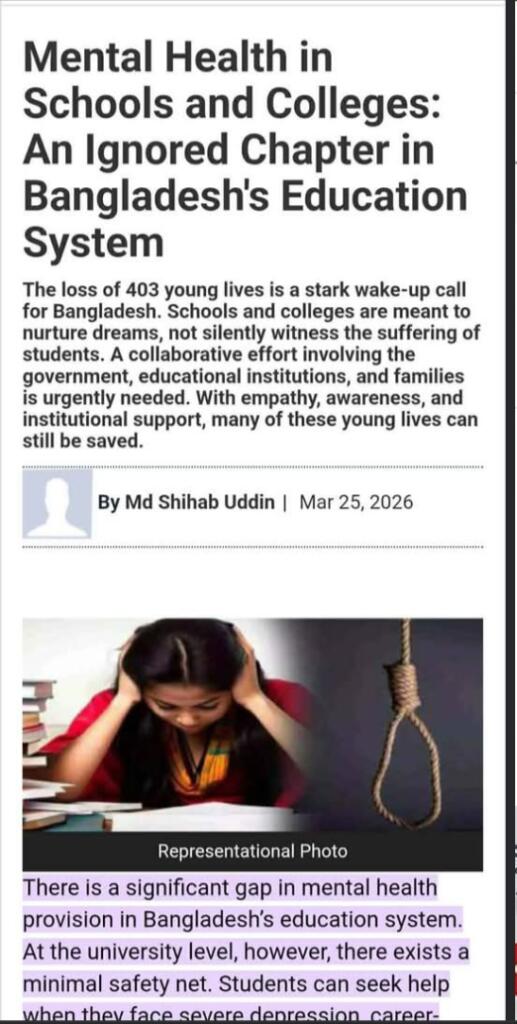
There is a massive gap in mental health provision in our education system. There is some minimum safety net for university students. They can go there when they are undergoing severe cases of depression, career stress or in case of personal crises. Student advisory centers exist in most of the big and public universities. Others have mental health psychology or even medical departments. In case a student requires assistance, he or she may consult a professional. This system is not perfect. However, it spares a lot of young adults the breakdown.
We fail to find this safe haven in the four walls of our colleges and schools. And this homelessness is precisely why hundreds of good lives are being wasted without a whisper. This fact is tragic evidence as shown in the 2025 survey report offered by the Aachol Foundation. The previous year there were 403 suicide cases among students who decided to take their life in the country. In 2024, the number was 310. The increase in just one year is not just a matter of personal despair. It is a stark indication of a gaping gap in the mental health provision of the education system.
The survey indicates a dreadful fact. Among the 403 students who committed suicide, 190 of them were school children. This is almost half of the total 47.4 percent. The other 92 were college students. Obviously, the greatest casualties are the adolescents. Suppose it is a 13 or 14-year-old teenager. A very big school-bag is on their shoulders. They bring the blinding obsession into their heads to be able to score a GPA-5. They encounter unrealistic expectations in the classroom. They also experience disorienting physical and psychological transformations. There is a huge storm that is roaring between their young minds.
But what is the count of that storm? When an adolescent is subjected to cyberbullying or is harassed by peers, the teenager retreats into shell. Where can they go? They do not have a professional counselor or psychologist in their school. They can find no one to have their suffocating feelings with, without feeling judged.
Further examination of the information reveals other ugly facts concerning our society. The number of tragic deaths among female students is much greater. More than 249 female students, which is approximately 61.8 percent of the total, committed suicide last year. Once girls enter the adolescence stage, society chains them without them noticing it. The limitations in the family, difficulties in relationships, and the current danger of cyberbullying destroy their psychological harmony. Cyberbullying is a specific cause of some of these suicides, which are observed in the survey. Remarkably, the image changes at the higher education stage. Out of the 77 students of the university who committed suicide, 41 were male and 36 were female. The anxiety of joblessness and pressure in establishing social standing struck at this point. The future is not certain and this makes young men face a serious identity crisis. The Dhaka division had the greatest number of suicide among students of 118. That is how the robotic existence of the cities, family alienation, and profound loneliness are consuming our young generation.
To prevent this chain of death, we should leave the culture of accusing people. Mere empty advice we can no longer give. The government is spending billions of dollars in the construction of multi-story school rooms. They set up digital labs. At the beginning of the year they distribute slick new books. These are certainly commendable initiatives to increase education. However, with this infrastructure, we are in urgent need to address the psychological safety of our students.
The answer is not inconceivably hard. It simply needs to be co-ordinated. It is impossible to employ a clinical psychologist in every school at once. But we can start step by step.First, we may educate normal teachers on simple psycho-social support. Educators should be aware of how to identify abnormal behavioral modification. When one student suddenly becomes quiet or his/her attention is lost, a teacher should be in a position to communicate with him/her in a friendly manner. A motherly teacher may be a first safe haven to the student. To this, the Ministry of Education and corresponding directorates ought to make efforts and ensure that mental health cells or counseling centers are established in every school and college, both public and private, in stages. An initial mental health screening can be implemented when students attend schools, or it can be introduced at the beginning of the academic year. Moreover, parent-teacher meetings are not to be concerned only with the rate of passing or passing exams. Schools may invite professionals to talk over adolescent mental health with their parents. Such a mere act would make the families a lot more aware and helpful.
The fact that these 403 students are losing their lives early is a huge wake up call to us all. Our schools and colleges have benches that are designed to dream of the future. They need not see the mute cry of a fellow student. The collaboration between the state and the educational institutions as well as families has to begin. Such bright young minds could only be saved with a bit of empathy and institutional mental support and would not fade.
Md Shihab Uddin