
Fertilizer shortage getting worse

মোঃ সিহাব উদ্দীন , University of Rajshahi
প্রকাশ: ২ মে ২০২৬ পাঠ: ১৩০ বার
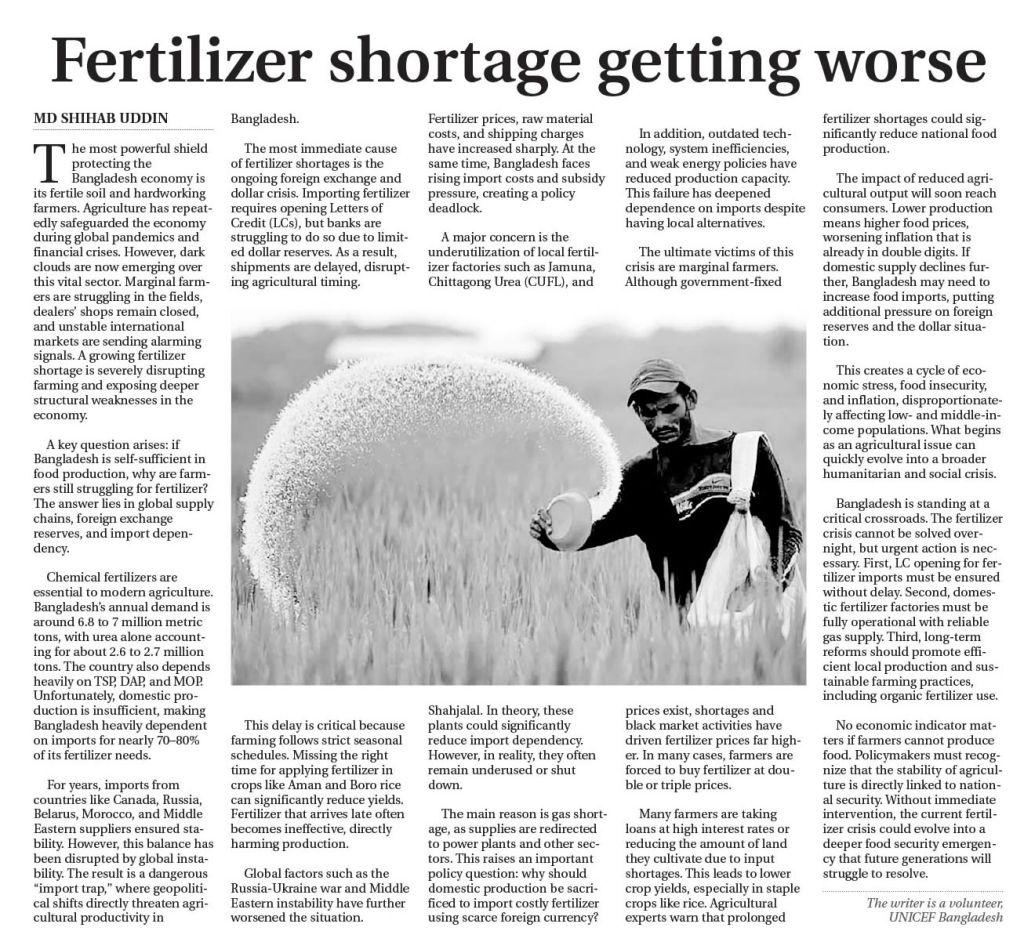
Bangladesh is an agricultural nation. Agriculture drives our economy. Our unstoppable farmers are its heart and soul. They brave the sun, rain, and storms to feed us. Their sweat paves our way to food self-sufficiency. But the reality is often harsh. When the peak farming season arrives, we face a deep crisis. This is the fertilizer crisis. We believe a fair fertilizer distribution system is an absolute must for a sustainable agricultural framework. Subsidized fertilizer must reach the marginal farmers seamlessly through dealers and sub-dealers. Ensuring this has become our national duty today.
Modern farming relies heavily on high-yielding crops. Timely application of chemical fertilizers like Urea, TSP, MoP, and DAP is essential for good harvests. The government provides thousands of crores of taka in subsidies every year. We do this to lower production costs and encourage our farmers. Our goal is clear. The real farmers working in the fields must receive this massive subsidy directly.
Yet, we often see this noble initiative derailed by dishonest syndicates. On paper, we have plenty of stock. In reality, the fields run dry. We must understand that this crisis is not a natural disaster. It is entirely man-made. It is a massive management failure.
Dealer and Sub-dealer Networks: Expectation vs. Reality
The government appoints dealers and sub-dealers at the union and ward levels. The primary goal is to deliver fertilizer right to the farmers’ doorsteps at fair prices.
But what do we see in reality? We find that this supply chain often turns into a hub of corruption. Some corrupt dealers and sub-dealers form syndicates. They create artificial crises. When farmers need fertilizer the most, these syndicates hoard the stock. They later sell it on the black market at inflated prices. Sometimes, we hear shocking news. A dealer might exist only on paper. The person has no shop or warehouse. They simply lift the allocation and sell the delivery slip to another trader. This middleman dominance destroys our main objective. It hurts both the government and the farmer.
Our marginal and smallholder farmers are the biggest victims of this mismanagement. They own very little land. They farm as sharecroppers or rely on heavy loans. Their situation is truly heartbreaking.
When fertilizer prices jump by hundreds of taka per sack, these farmers are pushed to the wall. We can feel their desperation. They often go bankrupt trying to buy high-priced fertilizer. Sometimes, they are forced to take high-interest loans from local moneylenders. Often, they simply cannot afford enough fertilizer for their crops. As a result, the crop yield drops drastically. This personal loss is not just theirs alone. It becomes a massive threat to our national food security. If we cannot protect our marginal farmers right now, tomorrow Bangladesh will face a severe food crisis.
Overcoming the Crisis: Our Action Plan
We need a radical overhaul of the current system to make it 100% corruption-free and farmer-friendly. To ensure fertilizer reaches the marginal farmer properly through dealers and sub-dealers, we propose these concrete and practical steps:
1. Complete Digitalization of Fertilizer Management: We live in the IT era. We cannot leave crucial sectors like fertilizer distribution in the dark ages. We believe the entire process must come under a central digital database. It must track the fertilizer from the factory or port all the way to the farmer. We can add QR codes or barcodes to every sack. This will make tracking flawless.
2. Introducing ‘Smart Farmer Cards’: We must identify genuine farmers and hand them ‘Smart Cards’. We propose storing each farmer’s fertilizer needs digitally on this card, based on their land size and crop type. When a farmer buys fertilizer, the dealer will swipe the card through a POS machine. No dealer will be able to create fake vouchers and sell fertilizer on the black market.
3. Absolute Transparency in Dealer Appointments: We must grant dealerships only to genuine and honest businesses, free from political influence or nepotism. We demand strict monitoring by the local administration to verify the physical existence of dealer shops and warehouses. Anyone breaking the rules must face immediate license cancellation and strict legal action.
4. Strict Oversight and Accountability of Local Administration: We must improve coordination among Upazila Agriculture Officers, Union Sub-Assistant Agriculture Officers, and local administrations. We want it mandatory for every dealer to hang a visible price list and stock update during peak seasons. The administration must run regular Mobile Courts. No one should dare to create an artificial crisis.
5. Direct Farmer Participation and Committees: We must include real, marginal farmers in ward and union-level fertilizer monitoring committees. We believe no distribution system can be fully successful without the direct participation of the beneficiaries. If farmers keep watch, dealers will fear committing irregularities.
6. Alternative Distribution Channels or Cooperative Models: We can build a parallel distribution system alongside dealers. We can use the farmers’ own cooperative societies. Farmers can directly collect fertilizer from companies or buffer godowns and distribute it among themselves at fair prices. This will eliminate the middlemen forever.
7. A Hotline for Complaints and Quick Resolution: Farmers must have a way to report any irregularities directly to higher authorities. We need a 24/7 toll-free national hotline. We want every farmer’s complaint treated with the utmost importance and resolved instantly.
“If the farmer survives, the country survives.” This is not just a slogan. It is the core mantra of our existence. We cannot let the fate of millions of our marginal farmers be held hostage by the greed of a few dishonest dealers. The government pays subsidies with public tax money. The sole beneficiary must be the country’s farmer.
We believe a combined goodwill, modern technology, and strict enforcement of the law can bring a revolution in the fertilizer distribution system. Our goal is singular. We want no shadows of despair in the farmer’s yard due to a lack of fertilizer. Instead, we want every marginal farmer’s granary to overflow with golden harvests.
Let us work together. Let us build a transparent and accountable agricultural system. Here, dealers and sub-dealers will not be exploiters. They will work as true friends and servants of the farmers. Only then will the wheels of our agriculture spin faster. Only then will our dream of a prosperous Bangladesh turn into reality.
Md Shihab Uddin
Volunteer, UNICEF Bangladesh
The author is an independent researcher and a student of Folklore and Social Development Studies at the University of Rajshahi.He may be contacted at shihab.fsds@gmail.com