
🎉The Day of Dhaka University.!🎊

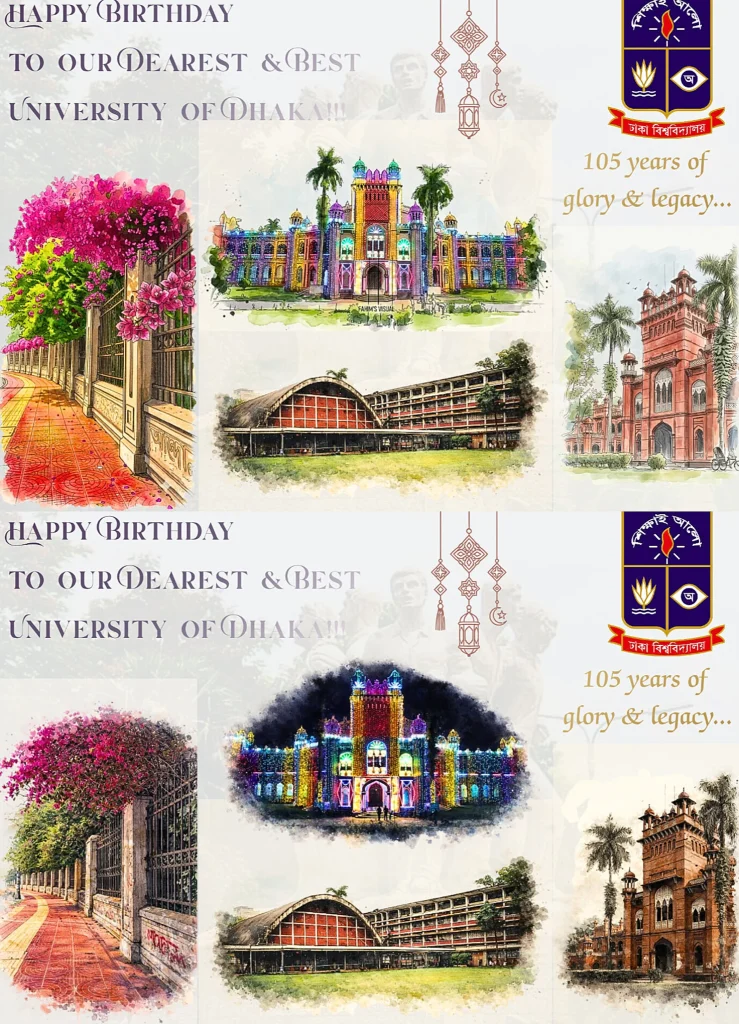
✒️🏫Happy Birthday, University of Dhaka!
Today, 1st July, marks the 105th anniversary of our dearest and best – University of Dhaka. Yes, it is the birthday of Dhaka University, one of the finest academic institutions of Bangladesh, and also of the world.
The establishment of this academic infrastructure holds immense significance in the tales and history of Bangladesh as well. This University was actually meant to be established as a compensation for the annulment of the 1905 Partition of Bengal. This partition had created East Bengal and Assam as a separate province, with Dhaka as its capital. But, due to intense political protests, the partition was abolished in 1911. Following this reunification in 1911, Muslim leaders, including Nawab Sir Khwaja Salimullah, Nawab Syed Nawab Ali Chowdhury and Sher-e-Bangla A. K. Fazlul Huq had meetings with Viceroy Lord Hardinge in 1912, demanding a university as compensation for losing the capital status. During the years 1912 & 1913, the British government officially appointed and approved the Nathan Committee’s report to create a detailed plan for this educational establishment. After that, the Secretary of State approved it in December 1913. However, in 1914, the beginning of the World War I unfortunately delayed the funding and construction of this university.
Regarding its construction, public opinion was solicited prior to the moment when the university scheme was given its final shape in 1913. For this, over 25,000 suggestions, letters, memoranda and feedback were submitted by citizens, educationalists, community groups and others. This ultimately caused sharp divisions along regional and religious lines and reflected heightening deep political tensions of the era amongst the public. On the one hand, the supporters, being highly in favour of this decision, suggested for:
•Affordable education and all other academic facilities, especially for the rural & poor students,
•Strong advocation for cultural representation by introducing Arabic, Persian, and Islamic studies in the main curriculum,
•Demand for local control; i.e., the university administration should be independent of Calcutta’s influence.
On the other hand, the opposers/opponents argued that this university scheme is rather “academic downgrading” and can be responsible for worsening the already-existing religious objections. They claimed that:
•Since Dhaka was a “backward” region, the institution should be a low-level agricultural or technical school instead of a full research university,
•Fierce opposition against certain departments, for example, Department of Islamic Studies, as these departments could secularly damage the education system.
Every good, useful initiative often faces useless, unwanted obstacles. Our Dhaka University, in this case, was no exception. The elite intelligentsia, politicians, and academic bodies based in the then Calcutta (now Kolkata) were against these decisions relevant to Dhaka University. The prominent figures and groups including Sir Ashutosh Mukherjee (Vice-Chancellor of Calcutta University), Surendranath Banerjee and Dr. Rashbehari Ghosh (West Bengal politicians/jurists), the Calcutta University Senate and others opposed the idea of this university. They opposed this simply because of their own selfish gains like budget concerns of their Calcutta University, loss of control due to a rival university, considering the basic human right of education unnecessary and worthless for the rural population of East Bengal just because of their egoism, etc. Out of this sheer oppostion, they literally started:
•Political lobbying by sending formal protests to the British Viceroy, with their wild, irrelevant and illogical claims that the university would culturally divide Bengal,
•Political unrests to cause a decade of delays, delaying the opening for almost 10 years from 1912 until 1921,
•Financial blackmail by forcing the British to allot extra funds for Calcutta University before Sir Ashutosh Mukherjee allowed Dhaka University to proceed,
•Hostile budget cuts after it opened by stripping the university of its 5 million taka from its reserve fund, thus creating severe financial crises.
Luckily, even though the supporters were minority in number by political influence, they were the majority in terms of the overall population. These supporters mostly hailed from East Bengal & they were among the Muslim Public. Whereas, those influential opponents, although minority in demography in this case, were mostly from West Bengal & they were “Calcutta Elites”. Therefore, with their genuinely pure intentions, firm determination, dedication, skilled professionalism and smartness, they tackled all these hindrances. In addition, they applied some of their main strategies against these resistances, such as:
•Direct political leverage to use their political influence for directly negotiating with the British Viceroys and conditioning their community’s political loyalty on the university’s building.
•Furthermore, the Nawab family of Dhaka and the local zamindars donated vast amounts of their own personal land and financial assets in the Ramna area, total amounting to 600 acres of land to eliminate the excuse of high setup costs, to eradicate the budget deficits of the government and for funding and land donations.
•Last but not the least, the Muslim leaders fiercely debated the opponents and their foul tactics inside the Bengal Legislative Council by using authentic data to expose the educational deprivation of East Bengal and also urging for the legislation of the “Dacca University Act” in 1920.
During the post-war time in 1917, the Imperial Legislative Council enacted the “Dacca University Act 1920” to legally establish the institution after the Calcutta University Commission (Sadler Commission) was appointed by the British to review and endorse the plans. Next, the first vice-chancellor of the university was Philip Joseph Hartog, who had been academic registrar of the University of London for 17 years. Afterwards, finally on this day, 1st July, 1921, Dhaka University officially started its journey by opening for classes with 3 faculties:
•Faculty of Arts,
•Faculty of Science,
•Faculty of Law.
12 departments:
•Sanskrit, •Bengali, •English, •History, •Philosophy, •Islamic Studies and Arabic, •Persian and Urdu, •Economics and Politics | •Mathematics, •Physics, •Chemistry | •Law | •Commerce
and 877 students.
These regular classes, administrative and office operations successfully continued with gradually increasing faculties, departments, students, popularity and reputation of the university. The students of Dhaka University (Dhabians) were among the best not only in studies, but also in the active participation when it comes to serving our country. The Dhaka University & its Dhabians have greatly impacted & shaped the most significant historical movements and unforgettable moments written in golden letters right from the start till the end of our time. They have contributed to:
•The Bengali Language Movement (1952), •The Six-Point Movement (1966), •The 1969 Mass Uprising, •The Bangladesh Liberation War (1971), •The Anti-Autocracy Movement (1990), •The July Revolution / Quota Reform Movement (2024), etc.
Dhaka University has gifted Bangladesh the best and the strongest alumni as well, being like a second home and the dream university to the pupils at the same time. The icons are:
•Dr. Muhammad Yunus, •Tajuddin Ahmad, •Humayun Ahmed, •Fazlur Rahman Khan, •Shamsur Rahman were the students.
Moreover,
•Kazi Nazrul Islam (awarded honorary doctorate and central figure), •Satyendra Nath Bose, •Sher-e-Bangla A. K. Fazlul Huq, •Sufia Kamal, •Fazlur Rahman Khan, •Munier Chowdhury, •Govinda Chandra Dev and many more of the most famous figures were associated with Dhaka University as alumni, faculties and even researchers.
Dhaka University is one of the best things that has ever happened to Bangladesh. The overall existence and identity, honour pride and dignity of a state most importantly depends on its own backbone – education. This University has always been like the powerhouse of the best sons & daughters of our nation and added to our culture, history and such innumerable aspects so far, which was once impossible even in our dreams without it. Credits to DU for the merits and blessings as students who are like the treasures and jewels of our country serving home and abroad, making all of us proud and inspirational.
Eventually, the University of Dhaka has now become one of the most inseparable part of our life, ultimately making the backbone & base of our prosperity even stronger and better. We can conclude that, the University of Dhaka emphasizes enriching and upgrading our way of life with the help, opportunities and facilities it provides, motivates us to walk together, through thick and thin, no matter what, in this path towards the better days ahead. Hence, it is our duty and responsibility to protect and maintain this asset at all costs instead of taking it for granted and slowly ruining its surroundings, security, qualities, services and signature characteristics.
Today, the University of Dhaka stands atop with a sum of 13 faculties, 83 departments and a family of 37,018 regular students. Let’s all work together and pray that the University of Dhaka keeps evolving and enhancing with its aura, prime, glory and legacy forever.📖🎓