
IS INFRASTRUCTURE DEVELOPMENT THE TRUE SYMBOL OF REAL PROGRESS?

IS INFRASTRUCTURE DEVELOPMENT THE TRUE SYMBOL OF REAL PROGRESS?
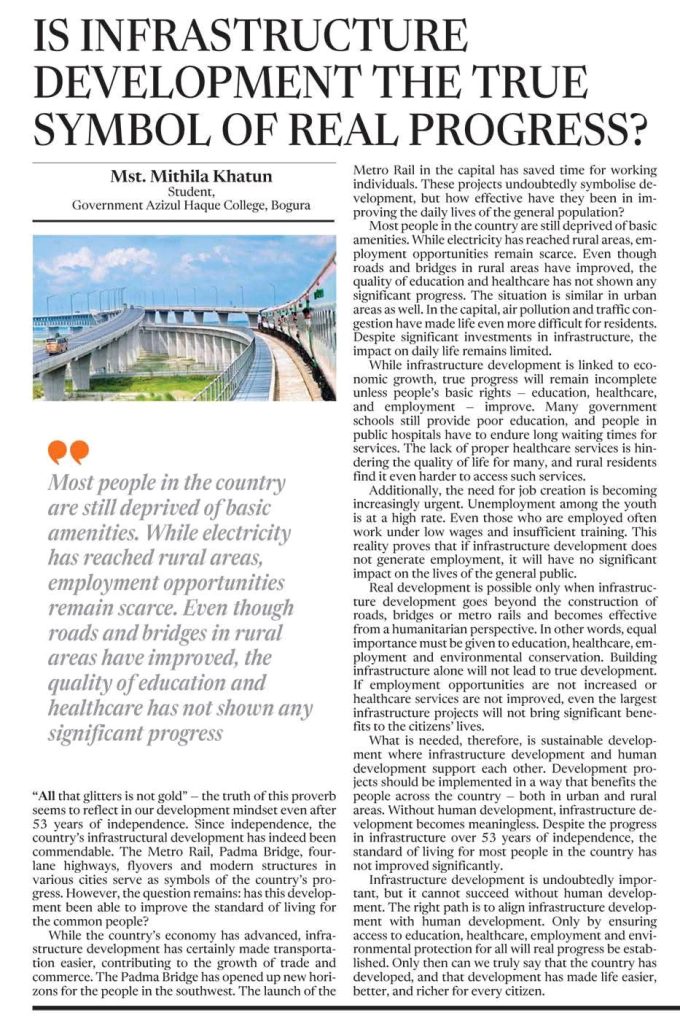
“All that glitters is not gold” – the truth of this proverb seems to reflect in our development mindset even after 53 years of independence. Since independence, the country’s infrastructural development has indeed been commendable. The Metro Rail, Padma Bridge, four lane highways, flyovers and modern structures in various cities serve as symbols of the country’s pro-gress. However, the question remains: has this develop-ment been able to improve the standard of living for the common people?
While the country’s economy has advanced, infra-structure development has certainly made transporta-tion easier, contributing to the growth of trade and commerce. The Padma Bridge has opened up new hori zons for the people in the southwest. The launch of the
Metro Rail in the capital has saved time for working individuals. These projects undoubtedly symbolise de-velopment, but how effective have they been in im-proving the daily lives of the general population?
Most people in the country are still deprived of basic amenities. While electricity has reached rural areas, em-ployment opportunities remain scarce. Even though roads and bridges in rural areas have improved, the quality of education and healthcare has not shown any significant progress. The situation is similar in urban areas as well. In the capital, air pollution and traffic con-gestion have made life even more difficult for residents. Despite significant investments in infrastructure, the impact on daily life remains limited.
While infrastructure development is linked to eco-nomic growth, true progress will remain incomplete unless people’s basic rights education, healthcare, and employment improve. Many government schools still provide poor education, and people in public hospitals have to endure long waiting times for services. The lack of proper healthcare services is hin-dering the quality of life for many, and rural residents find it even harder to access such services.
Additionally, the need for job creation is becoming increasingly urgent. Unemployment among the youth is at a high rate. Even those who are employed often work under low wages and insufficient training. This reality proves that if infrastructure development does not generate employment, it will have no significant impact on the lives of the general public.
Real development is possible only when infrastruc-ture development goes beyond the construction of roads, bridges or metro rails and becomes effective from a humanitarian perspective. In other words, equal importance must be given to education, healthcare, em-ployment and environmental conservation. Building infrastructure alone will not lead to true development. If employment opportunities are not increased or healthcare services are not improved, even the largest infrastructure projects will not bring significant bene-fits to the citizens’ lives.
What is needed, therefore, is sustainable develop-ment where infrastructure development and human development support each other. Development pro-jects should be implemented in a way that benefits the people across the country both in urban and rural areas. Without human development, infrastructure de-velopment becomes meaningless. Despite the progress in infrastructure over 53 years of independence, the standard of living for most people in the country has not improved significantly.
Infrastructure development is undoubtedly impor-tant, but it cannot succeed without human develop-ment. The right path is to align infrastructure develop-ment with human development. Only by ensuring access to education, healthcare, employment and envi-ronmental protection for all will real progress be estab-lished. Only then can we truly say that the country has developed, and that development has made life easier, better, and richer for every citizen.
Student,
Government Azizul Haque College, Bogura