
The Cost of Cheap Labour

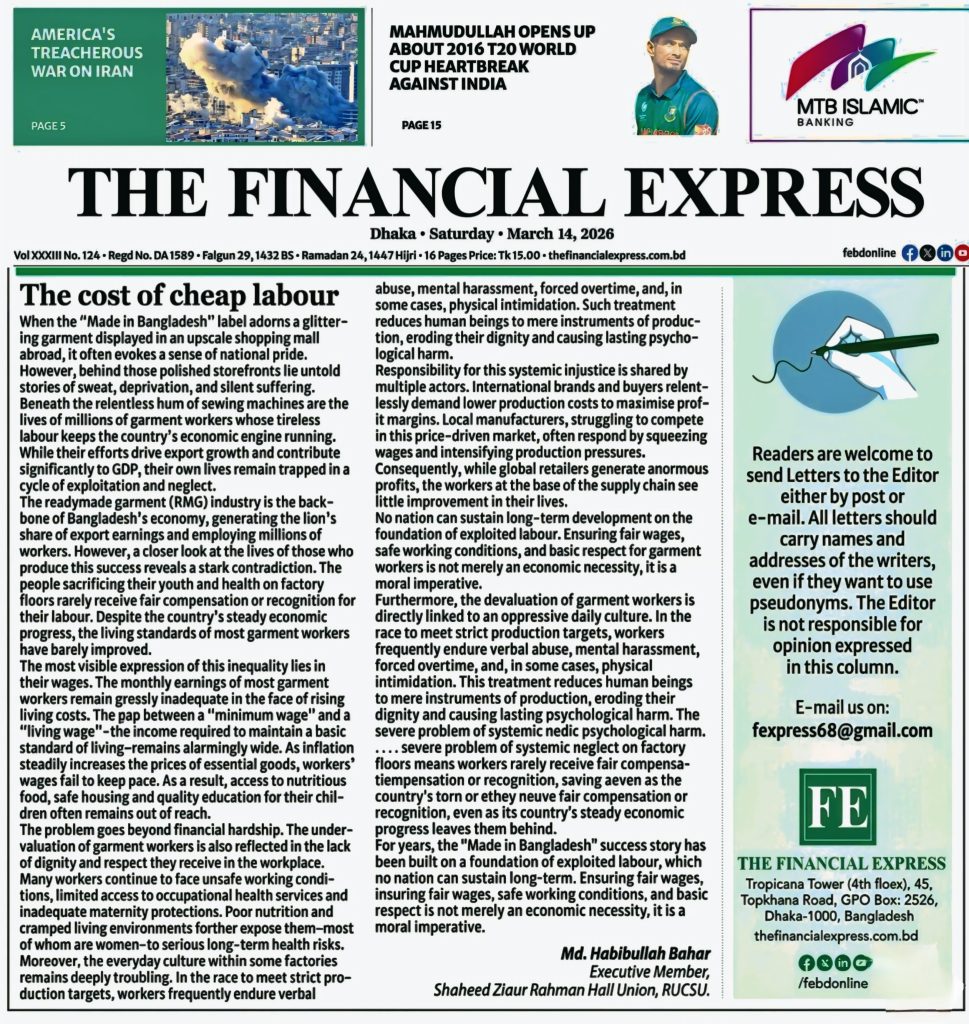
The Cost of Cheap Labor: The Dark Reality of the RMG Sector (Expressed, The Financial Express,14March -2026)
When the “Made in Bangladesh” tag shines on a glittering piece of clothing displayed in a high-end foreign mall, it fills us with immense pride. But how many of us pause to think about the stories of sweat, deprivation, and silent tears buried beneath those dazzling lights, drowned out by the relentless hum of sewing machines? The lives of the garment workers, the very people who keep the wheels of our economy turning, have been reduced to a tale of endless exploitation. While their backbreaking labor drives our GDP upward, their own destinies remain trapped in a vicious cycle of severe undervaluation and indignity.
The Ready-Made Garment (RMG) industry is the driving force of Bangladesh’s economy, generating the lion’s share of our export earnings. However, a deeper look into the living standards of the makers behind this astronomical success reveals a stark contradiction. For the people sacrificing their youth and health on the factory floors, fair valuation of their labor remains an elusive dream. While the country’s economic growth continues to soar, the living standards of these workers remain painfully stagnant.
The most glaring manifestation of this undervaluation is their wages. The remuneration handed to a garment worker at the end of the month is woefully inadequate against today’s skyrocketing market prices. The gap between a ‘living wage’–the amount necessary for a decent standard of living-and the ‘minimum wage’ they receive is so vast that their existence is basically an endless struggle for survival. As inflation pushes the prices of daily essentials out of reach, workers’ incomes fail to keep pace. Consequently, dreaming of nutritious food, decent housing, or quality education for their children becomes a mere luxury.
However, the failure to properly value these workers goes beyond financial metrics; it is a profound social and psychological degradation. When a hardworking human being is treated merely as a tool of production or a ‘source of cheap labor,’ their human dignity is stripped away. Basic rights such as a safe working environment, occupational health, and maternity leave often remain confined to paper. Due to a lack of nutritious food and unhygienic living conditions, these workers- a vast majority of whom are women- face severe long-term health risks. Yet, under the immense pressure to meet daily ‘production targets,’ their physical and mental exhaustion is blatantly ignored.
This systemic devaluation does not stop at financial or health deprivation; it takes a more hostile form in the everyday behavior inside the factories. The inhuman treatment workers constantly endure from supervisors in the name of meeting targets is, simply put, unacceptable. Verbal abuse over trivial mistakes, mental harassment, forced overtime, and sometimes even physical assault have become an unwritten, toxic culture within the industry. They are expected to function like tireless machines; asking for a brief rest due to illness is treated as a severe offense. When an adult is constantly subjected to such an intimidating and humiliating environment, it not only shatters their self-esteem but inflicts deep psychological trauma.
Both global and local stakeholders share the blame for this structural oppression. International buyers and global brands constantly seek the lowest prices to maximize their profit margins. To survive this unequal competition, local factory owners often resort to suppressing workers’ wages and applying immense mental pressure to maximize output in minimum time. As a result, while global brands generate billions in revenue, the workers at the very bottom of the supply chain see no meaningful change in their lives. They are left in the dark—architects of the economy with empty pockets and trampled dignity.
Ultimately, it is undeniable that no country can sustain long-term development built on the exploitation of its working class. The crisis regarding the remuneration, workplace respect, and fair evaluation of garment workers is not just an industry-specific issue; it is a question of our national conscience and human morality. Without ensuring fair wages and human dignity for these workers, the story of our macroeconomic success will remain incomplete, forever tainted by the dark stains of exploitation.
Md. Habibullah Bahar,Executive Member, Shaheed Ziaur Rahman Hall Union, RUCSU.