
Shadow Cabinet: Why Is It Essential for Politics?

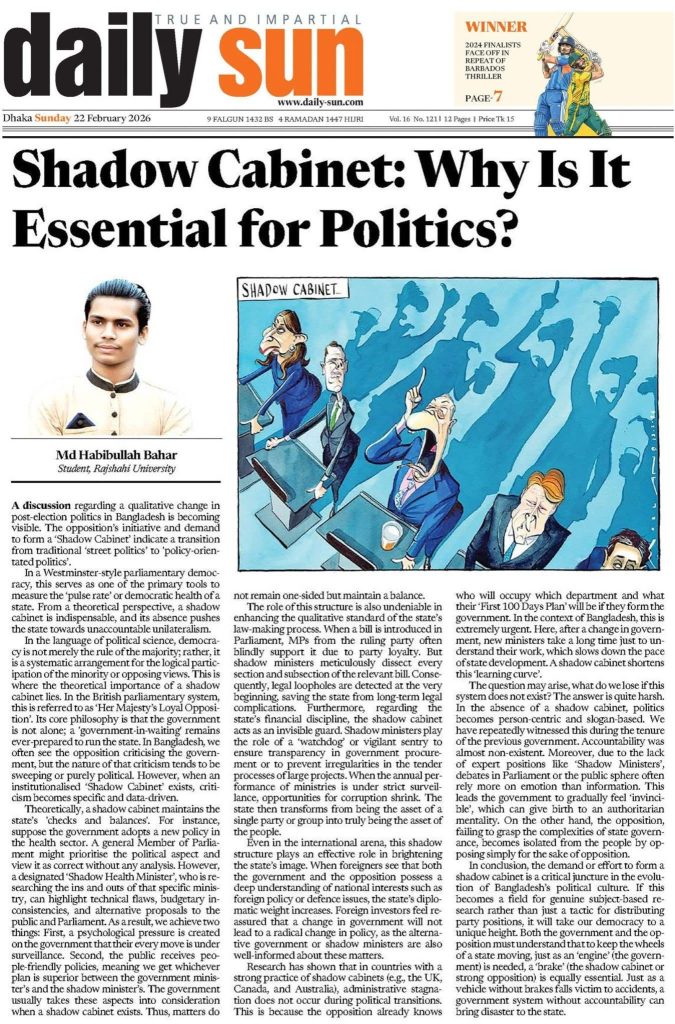
Shadow Cabinet: Why is it Essential for Politics?
A discussion regarding a qualitative change in post-election politics in Bangladesh is becoming visible. The opposition’s initiative and demand to form a ‘Shadow Cabinet’ indicate a transition from traditional ‘street politics’ to ‘policy-oriented politics.’
In a Westminster-style parliamentary democracy, this serves as one of the primary tools to measure the ‘pulse rate’ or democratic health of a state. From a theoretical perspective, a shadow cabinet is indispensable, and its absence pushes the state toward unaccountable unilateralism.
In the language of political science, democracy is not merely the rule of the majority; rather, it is a systematic arrangement for the logical participation of the minority or opposing views. This is where the theoretical importance of a shadow cabinet lies. In the British parliamentary system, this is referred to as ‘Her Majesty’s Loyal Opposition.’ Its core philosophy is that the government is not alone; a ‘Government-in-waiting’ remains ever-prepared to run the state. In Bangladesh, we often see the opposition criticizing the government, but the nature of that criticism tends to be sweeping or purely political. However, when an institutionalized ‘Shadow Cabinet’ exists, criticism becomes specific and data-driven.
Theoretically, a shadow cabinet maintains the state’s ‘Checks and Balances.’ For instance, suppose the government adopts a new policy in the health sector. A general Member of Parliament might prioritize the political aspect and view it as correct without any analysis. However, a designated ‘Shadow Health Minister,’ who is researching the ins and outs of that specific ministry, can highlight technical flaws, budgetary inconsistencies, and alternative proposals to the public and Parliament. As a result, we achieve two things: First, a psychological pressure is created on the government that their every move is under surveillance. Second, the public receives people-friendly policies—meaning we get whichever plan is superior between the government minister’s and the shadow minister’s. The government usually takes these aspects into consideration when a shadow cabinet exists. Thus, matters do not remain one-sided but maintain a balance.
The role of this structure is also undeniable in enhancing the qualitative standard of the state’s law-making process. When a bill is introduced in Parliament, MPs from the ruling party often blindly support it due to party loyalty. But shadow ministers meticulously dissect every section and sub-section of the relevant bill. Consequently, legal loopholes are detected at the very beginning, saving the state from long-term legal complications. Furthermore, regarding the state’s financial discipline, the shadow cabinet acts as an invisible guard. Shadow ministers play the role of a ‘watchdog’ or vigilant sentry to ensure transparency in government procurement or to prevent irregularities in the tender processes of large projects. When the annual performance of ministries is under strict surveillance, opportunities for corruption shrink. The state then transforms from being the asset of a single party or group into truly being the asset of the people.
Even in the international arena, this shadow structure plays an effective role in brightening the state’s image. When foreigners see that both the government and the opposition possess a deep understanding of national interests—such as foreign policy or defense issues—the state’s diplomatic weight increases. Foreign investors feel reassured that a change in government will not lead to a radical change in policy, as the alternative government or shadow ministers are also well-informed about these matters.
Research has shown that in countries with a strong practice of shadow cabinets (e.g., the UK, Canada, Australia), administrative stagnation does not occur during political transitions. This is because the opposition already knows who will occupy which department and what their ‘First 100 Days Plan’ will be if they form the government. In the context of Bangladesh, this is extremely urgent. Here, after a change in government, new ministers take a long time just to understand their work, which slows down the pace of state development. A shadow cabinet shortens this ‘learning curve.’
The question may arise, what do we lose if this system does not exist? The answer is quite harsh. In the absence of a shadow cabinet, politics becomes person-centric and slogan-based. We have repeatedly witnessed this during the tenure of the previous government. Accountability was almost non-existent. Moreover, due to the lack of expert positions like ‘Shadow Ministers,’ debates in Parliament or the public sphere often rely more on emotion than information. This leads the government to gradually feel ‘invincible,’ which can give birth to an authoritarian mentality. On the other hand, the opposition, failing to grasp the complexities of state governance, becomes isolated from the people by opposing simply for the sake of opposition.
In conclusion, the demand or effort to form a shadow cabinet is a critical juncture in the evolution of Bangladesh’s political culture. If this becomes a field for genuine subject-based research rather than just a tactic for distributing party positions, it will take our democracy to a unique height. Both the government and the opposition must understand that to keep the wheels of a state moving, just as an ‘engine’ (the government) is needed, a ‘brake’ (the shadow cabinet or strong opposition) is equally essential. Just as a vehicle without brakes falls victim to accidents, a government system without accountability can bring disaster to the state.
Md. Habibullah Bahar
Publicity Secretary, Rajshahi University Young Column Writers Forum.