
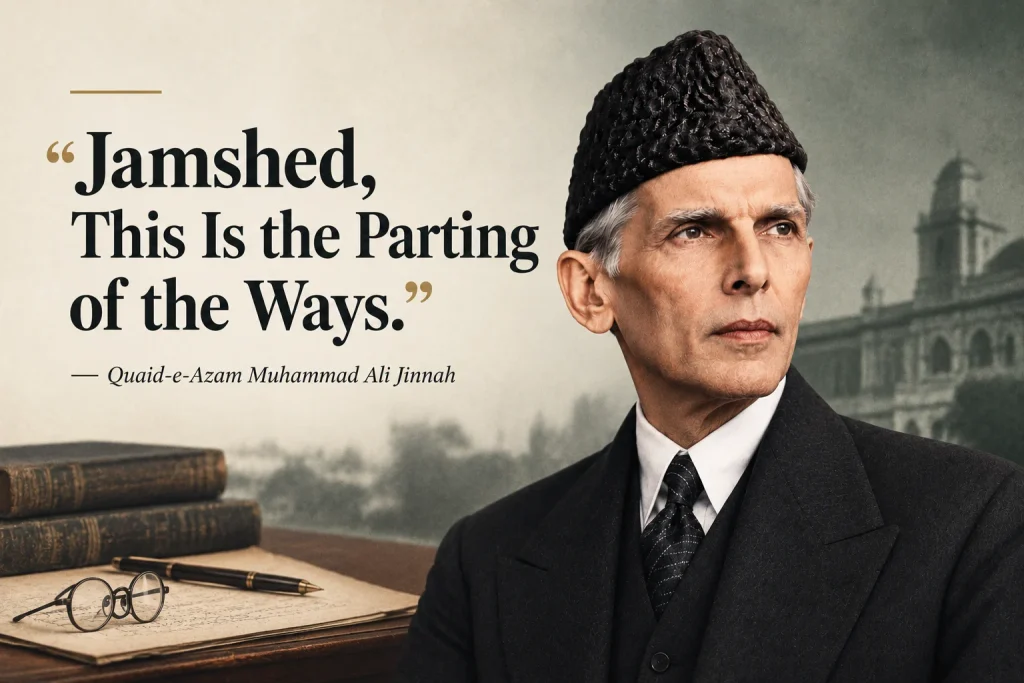
“Jamshed, This Is the Parting of the Ways.”

History occasionally presents figures whose life trajectories resist simple categorization or dogmatic framing. Their political journeys are defined by dramatic turns, complex evolutions, and intense historical debates. Quaid-e-Azam Muhammad Ali Jinnah remains one such enigmatic personality. But does history view Jinnah merely as the architect of Pakistan? Looking through an objective historical lens reveals a more intricate narrative: the profound transformation of a man who began as an ardent champion of Indian unity and ultimately became the founder of a sovereign homeland for a disenfranchised community.
The Ambassador of Unity & His Early Politics
In the early chapters of his career, Jinnah was far from a dogmatic separatist. A suave, impeccably polished young barrister, he was once described by Lady Wavell as being “as attractive as a Greek statue.” When he joined the Indian National Congress, Mahatma Gandhi welcomed him enthusiastically, calling him a fine “English Brain.” Prominent academic Dr. C.R. Reddy noted that “Jinnah is the pride of all India, not just the exclusive property of Muslims.” As late as 1934, addressing the Bombay Muslim Students’ Union, Jinnah declared unequivocally: “I am an Indian first, and a Muslim afterwards.” He sincerely believed that Hindu-Muslim unity was the prerequisite for liberation from British colonial rule.
Disillusionment, Plight of the Marginalized, and the Demand for Sovereignty
However, the harsh realities of Indian party politics soon fractured that ideal. The turning point arrived at the 1928 All-Parties National Convention in Kolkata. Jinnah presented three fundamental amendments to the Nehru Report to safeguard basic Muslim representation. Yet, Congress leadership and Hindu Mahasabha figures rejected his proposals through sheer voting power. Walking out of the convention deeply grieved, Jinnah remarked to his friend Jamshed Nusserwanjee with tears in his eyes: “Jamshed, this is the parting of the ways.” This bitter experience birthed his famous ‘Fourteen Points’ in March 1929.
Beyond political friction lay the stark socio-economic oppression of marginalized Muslims. Touring rural East Bengal in 1937, Jinnah witnessed the agonizing poverty of peasant families. While impoverished farmers produced golden jute with their sweat, Marwari traders and landlords extracted immense wealth, shipping it to Kolkata while leaving the peasantry in destitution. Speaking to Muslim League workers in Kolkata in 1946, Jinnah recalled this imagery, emphasizing that without political power and sovereign self-determination, protecting these disenfranchised masses from systemic exploitation was impossible.
British Viceroy Lord Mountbatten would later reflect on Jinnah’s unyielding resolve: “He was a rock of a man whom I couldn’t soften no matter how hard I tried.” Sir Frederick James described him as a “fearless and impeccably incorruptible figure.” Concealing a terminal case of tuberculosis, Jinnah fought relentlessly to realize Pakistan in 1947.
The 1948 Language Controversy and Late Reflection
Yet, contrasting this historic achievement stands the most controversial chapter of his legacy: the 1948 state language debate. In March 1948, addressing crowds at Dhaka University’s Curzon Hall and the Racecourse Ground, Jinnah declared that “Urdu, and only Urdu, shall be the state language of Pakistan.” In doing so, he failed to grasp the deep linguistic and cultural ethos of East Bengal’s majority population.
While central bureaucrats and ruling elites shared responsibility for this policy, for a strategist of Jinnah’s caliber, disregarding the mother tongue of the majority was a monumental strategic misstep. In his final months at Ziarat, struggling against failing health, Jinnah felt the weight of the growing discontent in East Bengal and the factionalism in Karachi. He increasingly realized that enforcing a singular language had fractured the very foundation of his dream state.
An Objective Historical Assessment
Evaluating Jinnah today requires neither blind admiration nor sweeping condemnation. Through an analytical lens, Jinnah emerges as a complex historical figure—a leader who abandoned the ideal of an undivided India to secure the political and socio-economic emancipation of a vulnerable minority. Yet, his inability to accommodate the cultural realities of East Bengal remains a tragic flaw in his statecraft. Acknowledging both his sharp intellect and his profound miscalculations allows for a truly balanced and honest historical appraisal.